
Book Review – Luke Rhinehart – The Dice Man 1971

Book Review – Luke Rhinehart – The Dice Man 1971 Harper Collins.
Book Club choice for July 2026. Beer & Books book club, Vinyl Tap, Preston.
Spoiler alerts.

Though not recommended for the group by myself this is a book I am very familiar with and one I stumbled on in a very unusual way. How do you decide what book you would like to buy or read? If you are like me it will be because;
1/. You read other work by the author
2/. You liked the cover or back cover blurb when browsing in the book shop/
3/. Someone recommended it to you.
4/. You just thought you’d try it because it was there.
5/. A book club choice.
6/. Because a stranger, inspired by the book, kissed you in a crowded pub.
I’m betting the last option here I more unique to me. The book inspired a lot of students to play dare games based on chance. Six different dares would be jotted on a note pad, and the dice (die in singular) would be thrown and the person that got that number had to perform that challenge or forfeit.

In the late 1980’s one lucky lady was fortunate, or unfortunate, in getting the task of kissing a total stranger in a crowded bar and she picked me. She was pleasant and even apologetic about it afterwards and she explained to me that the game was inspired by the Rhinehart book, which I later found and read. I could just as easily ended up kissed by one of her male friends had he got the right number and one of their previous dice-dictated quests had been to run into a crowded branch of MacDonald’s yelling Meat Is Murder.
When I read this c.1988 I loved it. Re-reading it for the book club in 2026, I was quite shocked and saddened to see how mysogenistic, sexist, racist and sloppy it actually is. It made me wonder what kind of guy I really was nearly 40 years ago.
The book’s central idea is clever though I never felt an urge to follow its premise myself, even temporarily. I like a life of order and stability rather than chaos. I like to feel I still need some degree of control.
Unusually for an obviously fictional novel like this, Rhinehart uses his own name and a first person point of view narration, which gives the book a documentary-autobiographical feel. At least that is the impression he would like to give. In fact, Rhinehart was a pseudonym for George Cockcroft. (an identity not tracked down and exposed until as late as 2019).
In the book, Rhinehart decides to randomise his life by making every moral and social decision on the throw of a dice. It soon becomes an addiction for him. He even makes references to the god of Wim and chance. The dice begin to dictate every decision in his life from what to eat, who to date, whether or not to commit rape (he does) and whether or not to commit murder. (He does).
The choice to rape Arlene isn’t a late decision coming after multiple dice fuelled adventures and events have pushed him to make increasingly dangerous choices, but one of the first roll if the Di decisions he makes, and he makes raping Arlene the option on his list for number one, with five options not to harm her, a dice-governed game of Russian Roulette. His desire to rape Arlene is obviously strong before he blames it on the dice. Apparently, if you do it well enough women love you for raping them like a proper man! Er, no Luke (George). I found myself thinking that if the dice had come up saying no to the raping he would have done it anyway or rolled the dice again (best out of 3,5,711…)
Rhinehard frequently boasts of how sexually well endowed he is. The rape becomes a seduction as Arlene seems rather too accepting and tolerant of his assault. The sexism of the book runs riot. One line describes a blow-job event with, "I encouraged her to baptize the uncircumcised child with the sacred water of her mouth."
As a psychiatrist, Rhinehart begins to use the dice in his decisions for his patients, and openly encourages them to use dice in their own decision making processes, which creates a craze and a cult for dice-teachings, and causes great offence to the school of Psycho-therapy in which Rhinehart works. There are moments of great humour, such as the parties at which Rhinehart disrupts through his constantly contrary and eccentric behaviour dictated by chance. He abandons a sense of responsibility and blame. It’s a dangerous delusion. The Dice don’t make him do anything. He tells the dice what to pick for him. Choosing rape or not rape is very different from picking tea or coffee, or which film to watch at the multiplex. Not to Rhinehart though.
At one point the dice tell him to be Jesus for the day. To many, he has simply lost his mind. Perhaps he has. Perhaps he is the sanest man left in America. Rhinehart himself becomes unpredictable and uncontrollable, just as a gambling addict would, and effectively ruins his material life, his job, income, etc, but he finds the randomising chaotic process highly liberating. He completely loses regard for the distress and hurtful impact he has on family, friends and work. He is consumed by his narcissistic egotism, not truly liberated. He is still seen at the end of the story being pursued by the authorities for his crimes but somehow happier than he has ever been before in his life.
The book is a savage satire on the American obsession with psychotherapy and religion, and a materialistic world outlook in which few would dare to take such wild dangerous chances, and decisions just for the sheer hell of it. As Rhinehart’s activity is very anti-social, and destroys social and financial attachments, his lifestyle is often presented as a new form of Buddhism. Several Zen Kuan style allegories are used, including the closing image of Rhinehart’s character hanging from a cliff edge by his fingertips but contemplating reaching for a lovely flower just about in his field of vision, a reach that would certainly cause his final fall, but the idea reflects much in the book. Every slight chance is an opportunity and worth the risk. The fall is possibly worth it. The end result of dice-play living is nihilism – nothing matters at all.
Rhinehart (Cockroft) was highly influenced and influencing on the New Age counter-culture. After taking part in one of their four day intensives, Rhinehart wrote the Ehrhard Seminar Training handbook, EST, for Werner Erhard’s EST organisation which applieds religious cult tactics to business and sales management corporations. Companies would send high-level sales staff on an EST course. They would be locked in rooms, insulted, abused (sometimes physically), treated as worthless, until broken, and then built up afresh as hard-selling company ethos fired sharp-shooters. Many people subjected to the humiliations sued both EST and their companies for such practices, which are still used (though in more diluted forms) in many companies. The echoes of religion and new age spins on mysticism pervade the book and its near-sequels.
The problem with Dicing with life and death so literally is that you become monstrous. Rhinehard has sacrificed all moral responsibility, believing and claiming that the dice calls the shots and attributing his behaviour to the god of Wim. However, he sets out the choices the dice rolls pick for him, including the opening rape gambit. A truly moral man wouldn’t contemplate rape, let alone try it. Rhinehart casually makes rape an option to chose from. Again, later with murder. The dice can only decide between the options he already generated and put into the rolling of the die. The problem with the book is that Cockcroft tries to peddle his alter ego as an anti-heroic maverick, not a monster.
This reads at times as a subversive and often extremely funny book, and it is extremely tempting to get a set of dice out and try some of the hopefully more harmless games for yourself. However the negatives outweigh its brighter aspects and it goes on way too long.
Re-read in 2026, the book still has a fun concept but seems terribly dated. The use of more complex Live Action Role Playing dice in strategy games shows that a simple 1-6 choices range is too limited, and how messed up linear story telling gets.
Rhinehard is also dreadfully racist and sexist to the modern sensibility. Rhinehart, as author and character comes over as an amoral sexist, selfish prick, not the subversive anti-establishment subversive force of liberation he’d like the World to remember him as.
Three sequels followed, only one being a direct follow up to the original.

Adventures Of Wim, (1986) (also issued as ‘Whim’) is described as a sequel (sort of) to The Dice Man. In fact, it is nothing of the sort. There are some thematic parallels, in that Wim ends up in a life dictated by chance, but unlike Rhinehart in The Dice Man) Wim isn’t creating chance, but finding it playing with him. At no point does he ever touch or play with dice.
Wim’s story is told by a whole cluster of increasingly unreliable narrators, including his Mother, an ageing fisherman, and unknown third person narrators. There are even extracts from conflicting biographies and scripts from film treatments on his life. There are several quotations from The Book Of Luke, but the neo-Gospel author is Luke Frith, not Luke Rhinehart).
Wim is born into the enigmatic and highly unlikely Montouk tribe of Native Americans, mysterious in managing to create the illusion of simply not existing, being extremely good at hide and seek. (The descriptions of the tribe are genuinely charming and funny, without being racist). The son of Widepool, Whim is born when his very pregnant mother’s labour is induced when a fisherman and tribal ‘Navigator; (prophet and shamen) (Grain Of Sand, or if you prefer, Grain Of Salt, someone whose stories, claims and prophesies should not be taken seriously, as he is obviously full of crap) takes her fishing from a boat with him and accidentally hooks her instead of a fish. The hook pulls Whim from her womb, and somehow failing to even notice Widepool was obviously 9 months pregnant, Grain assumes Whim is a miraculous virgin birth. Later the story circulates that Widepool was so beautiful that all the gods tried to have sex with her at once, causing their sperm to mingle, making Whim the son of every male deity there is. We later still find that Widepool was prostituting herself to local men, so Whim’s true father is never identified. Deconstruction of stories told in previous chapters becomes a recurrent motif in the book.
Though evading communication with white people, given the effects we had the native Americans in general, Whim grows up dangerously curious to meet us and ends up discovered by social workers who force Widepool to send him to school.
His naivety is often mistaken for wisdom, and Whim finds nothing truly matters. In the school American football team, Whim plays so badly and erratically that he confounds the opposing teams enough to score a high number of touchdowns. He becomes best mates to Billy, the highly materialistic star player. Whim also falls in love with a girl called Dawn who gets dragged along in his increasingly absurdist adventures.
Whim is subjected to racist abuse for being a dwarf and a native American. He tries to discover how to become invisible so he can get revenge on his enemies, but he learns that the secret of invisibility is to be at peace with everyone, so he has to sacrifice his anger to achieve it. He can only do it when he doesn’t have to. He then tries growing a Marjuana pot plant that grows like a Beanstalk in the fairy tale and becalms all who get near it, so foxes and rabbits become friends and the police raiding to destroy it end up having a spectacular love-In orgy. Sadly the pot plant proves to be only an overgrown tomato plant.
Grain tries to lure Wim away from the white people by sending him on a mission quest for Ultimate Truth, (often abbreviated to UT). And with Dawn & Billy, Wim sets off round the World in search of three wise gurus, even being chased by a Yeti in the Himalayas, ultimately learning that nothing matters and the best way to live is not giving a damn about anything. Wim himself gains a guru-following, but he never actively seeks any such power. Asked what UT is, Whim will show you a potato.
Not the Dice Man, almost its opposite, with much more genuinely likeable eccentric characters. This runs like a Cheech & Chong fantasia, and its a much better read than the book it falsely claims to be a sequel to.

The Search For The Dice Man (1999)
A more direct sequel to The Dice Man, set 15 years on from the first book. The focus isn’t on Luke, but his son, Larry Rhinehard, a successful Wall Street broker who has lived and succeeded on a business ethic of never taking chances, and maintaining order and methodology. Unfortunately, after years of being the goose that lays the golden egg, a few accounts fail through unexpected and unlikely forces and his reputation is tarnished. Worse, he is badgered by the FBI for information about Luke, who, after rumours of being dead, seems to be up to his old tricks again.
Not having heard from his dad in 15 years, Larry sets out to find him, which ends up highly problematic. He eventually finds Lukeland, a whole cult community in which everyone lives by dice decisions. Unable to get straight answers, Larry finds that he has to play the game hoping to find sense in chaos and meet Daddy by choice.
There is a clever collision or order and chaos. Larry ultimately keeps his head, and sees the need to use randomisers with caution.
The book plays on not only speculation on what happened to Luke the character but also the still elusive nature of Cockcroft, the author himself who would stay hidden for another decade but it is quite a dull book compared to The Dice Man and Whim. The big contradiction is that Luke has successfully established a cult-commune of anarcho-cynics where every dice throw by Luke and others could tear the commune apart, and despite his erratic life style he hasn’t left clues long since leading to his discovery and arrest. Cockcroft avoided discovery by just keeping quiet and running a little farm. Luke is too bombastic to avoid the spotlight, and any of his followers could cause his exposure or overthrow on a dice-inspired decision. Somehow it hasn’t happened in fifteen years?
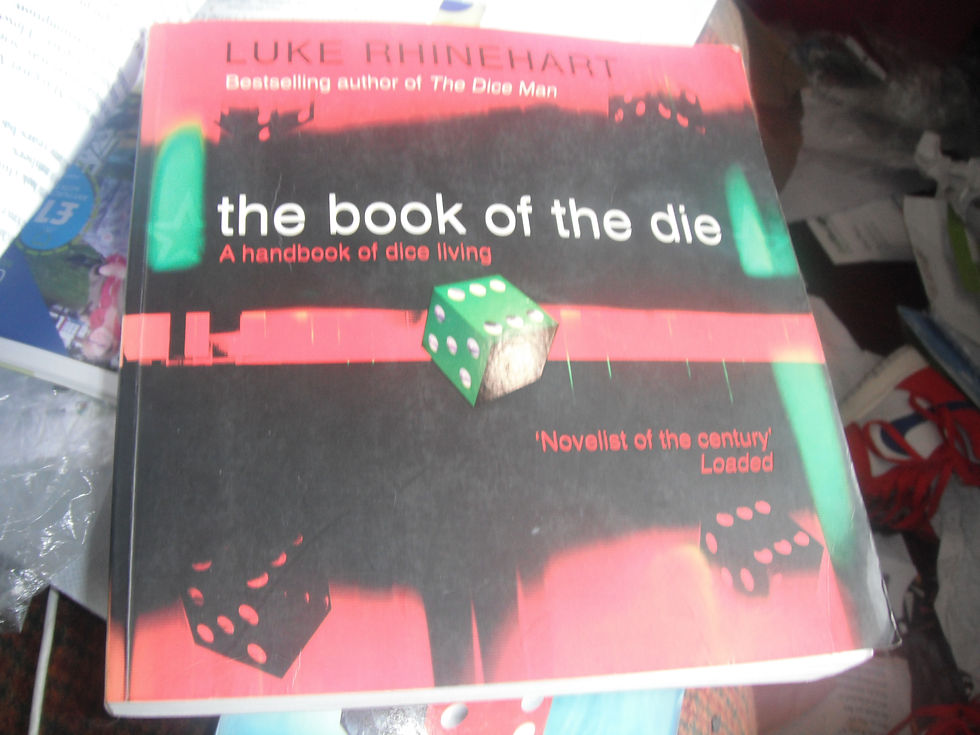
The Book Of The Die (2020)
Penned after Cockroft’s true identity became public, this isn’t a novel, but a series of short reflections, parables and dice games (some of the quotations are direct extracts from the three other books), and games/forfeits to play for Dice Man affectionateness. Rhinehart (Cockroft) himself advises the book is best read randomly, just by flicking through the pages and picking bits out. A bit of a cop out but sometimes quite entertaining. Given the extremely sexist nature of the parent book, it's no surprise that this was highly reccomended by Lad Mag, Loaded.

Big thanks as every month to all at Books & Beer, Vinyl Tap, Preston Lancashire, especially club organiser, Millie Angel. Next Book Club Read, Megan Lindholm's Reendeer People.
Arthur Chappell


Comments