
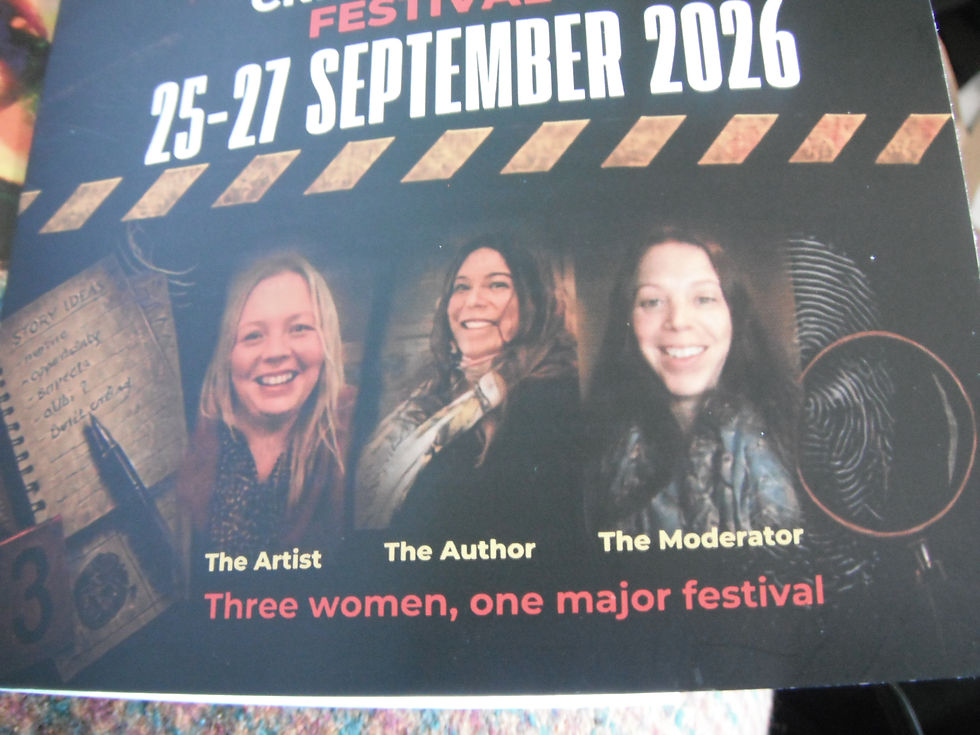
The First Preston Crime Fiction Festival 25-27 September 2026


Venue – Freemason’s Hall, Preston City Centre.
I have been to science fiction, fantasy and horror conventions since the late 1990’s but this was my first crime writer’s festival, and I thoroughly loved it. It won’t be my last.
While there are crime writing celebrations around the UK, most notably the annual Theakston sponsored annual event at The Old Swan in Harrogate, (the venue chosen for its links to Agatha Christie), this was the first such event to be held in my home city, Preston. The brainchild of local crime-author Christie J Newport, aided by her partner Amy Newport and Samantha Brownley, this was quite an ambitious and demanding event to organise, with dozens of leading authors attending as guests and supporters for panels, interviews, workshops and performances. Books were well promoted and without any in your face hard sell. Several remarkably generously donated freebies were on offer too.

The Venue was very welcoming, with a modest little bar, and very good food, all served with tremendous friendly service.
The emphasis was very much for police procedural crime writing rather than cosy crime or the classic Edwardian Whodunnit. The esteemed Mr Holmes only got mentioned in passing. Panels were friendly with lots of Q & A opportunity and the writers were all remarkably ego free and supportive to each other rather than competing for attention. When one writer due to be interviewed had to leave for a personal emergency, another author, Kate Bendelow, (who had already wowed everyone with an outrageously funny Noir At The Bar poem called ‘Dogging’) stepped in, for what became a brilliant and very funny improvised hour with interviewer, Christie Newport.

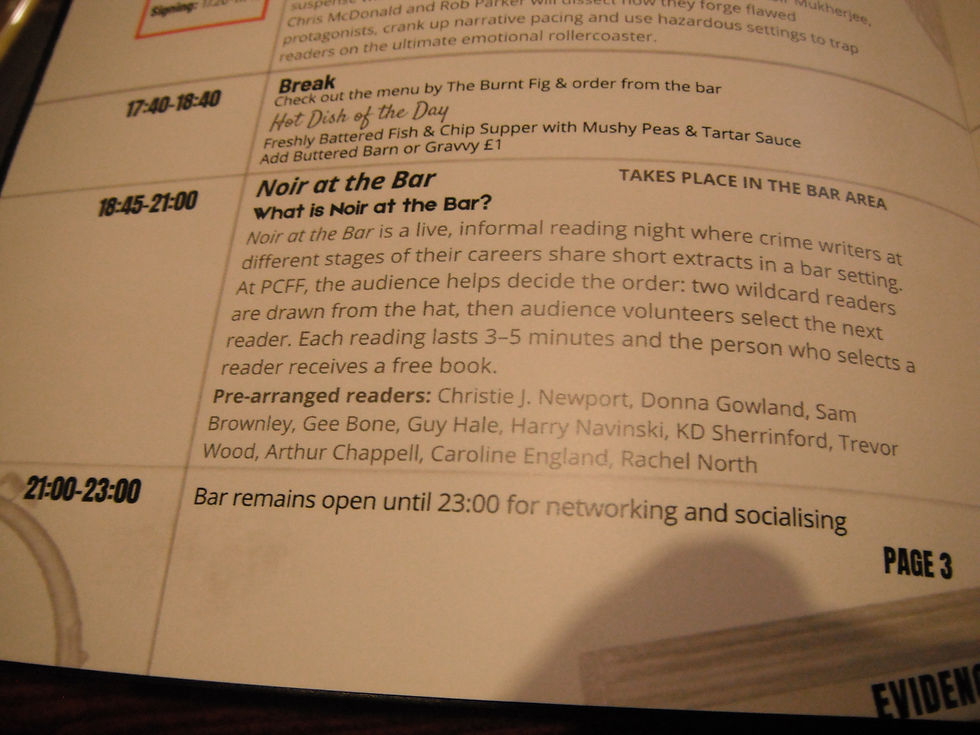
Noir At The Bar was the event at which I got to perform myself, with a poem called The Blue Bell Murders, actually a true crime themed piece on events that happened at a pub in the hosting city itself. About a dozen writers as well as Kate and myself, took part in this. I have added the text of the poem I shared here. https://arthurpeterchappell.wixsite.com/homepage/post/poem-the-blue-bell-murders

From the various panels it was becoming clear how well modern crime fiction is shaping up. The genre is increasingly popular, though authors seem to go for a retro era or exotic setting to avoid the plethora of CCTV, Doorbell Cameras, intense surveillance, etc that they feel makes many murders too easy to solve and criminals successfully vanishing almost impossible. Crime fiction works best with detectives able to talk to suspects and witnesses, creating more emotional reaction and interaction than having much of the increasingly clinical detection done in a lab. As one writer observed, realistically, modern detection methods might well have led to the capture of Peter (Yorkshire Ripper) Sutcliffe, much earlier in his murder spree and saved many lives. By the same rule, our CCTV saturation creates dystopian invasion of privacy and intrusion issues. The UK has more CCTV cameras in action than any country on Earth except North Korea. Vaseem Khan sets some of his work in India, with a detective (who has a pet baby elephant) as his chief crime solver. It neatly sidesteps the number of forensic solutions that would make lone-wolf thinking and deducing detectives like Colombo and Monk totally redundant in today’s techno-age.
Many writers attending were from the North West, with books set in the gritty shadowy, crime laden streets of Liverpool and Yorkshire, leading to interesting, amusing discussion on where the North starts and the South ends.
Crime stories have an architectural structure, rules and patterns readers will expect and often demand. The standard crime novel will start with a murder or abduction, or the discovery of a crime scene, body or bodies, etc. The detective will be brought into the story, the body will be identified (sometimes this may be postponed if identification is obstructed), Potential witnesses are questioned, suspects interrogated, complications arise, i.e., lost evidence, more killings, false confessions, disappearances, attacks on the detective, etc, the killer is identified, pursued, caught or killed trying to escape, the fates of other surviving characters are wrapped up…
Character matters more than plot. Think of The Hound Of The Baskervilles and the first image in your head will be Holmes, not the dog.
Real crimes and body identification stories often throw out unexpected twists. A chap who had committed suicide by leaping from a tall structure, hitting the ground feet first was not recognised by a loved one because of his shrunken height, where his leg bones had compacted down to make him look dramatically shorter than he had been in life.
There were several ‘Bespoke’ workshops and feedback sessions in a side-room, alongside the main panel presentations, and I took part in three of them.
The first for me was Donna Gowland’s step by step workshop on crafting historic period mysteries, with advice on research (looking up basic facts on Wikipedia, rather than deep trawling through obscure archives) is fine. The first step is to establish a chronology of actual events of the period, to establish the backdrop against which your story and characters appear. We were then invited to set out the outlines of a mystery in the times given. Several participants got to read out what they had written though time ran out before all of us could share our work, (perfectly understandably).
My outline related to events in the aftermath of the English Civil War, rooted in my proud involvement in Sealed Knot re-enactments of the period.

The second Bespoke event for me was a critiquing workshop one to one with Sean Watkin. Participants were invited to send in up to a 1,000 words of a crime related piece for his assessment. I submitted a short self contained futuristic story, set out entirely in dialogue. (It already exists as a short dramatic film or play script, from which the story was written, largely by compressing the work from the longer play. From Sean’s very thorough feedback, the compression shows, as it leaves a few unanswered questions and the dialogue seems a little unrealistic. The fixes to the piece will not be too arduous and Sean seemed to enjoy the work. His assessment of it was very comprehensive and I really appreciate the time and energy he put in prior to the festival for this.
There was a fascinating panel on the unreliable witness/commentator in crime fiction too. Aside from the killer who will often simply lie to hide his part in events, witnesses may be confused, traumatised into amnesia, or have their own secrets to protect.
The third bespoke event, the last actual event of the whole weekend in fact, was a step by step breakdown by author Vaseem Khan of the key ingredients for creating a crime/mystery novel. Character matters more than plot. Many crime stories begin with the murder or discovery of the body – an obvious hook in creating an exciting situation/problem from page one. Who died and why? How? Who did it? The characters doing the detecting feed the answers to the reader. There will be clues, found at crime scenes or through questioning of witnesses/suspects.
The layers of intrigue need to be multiple. Take The Hunger Games. The protagonist is chosen for the deadly dystopian games. Who is she? Will she survive? What are the rules? How did this society come about? Who supports/opposes it all? What dangers will be faced? What rules might be broken? There must be sub plots, complications, challenges. With crime as much as in Dystopian SF. There must me themes and meaning and messages. What is the writer trying to say about society? Crime doesn’t pay? Trust no one? Corruption in the system? Good (or evil) will prevail?
A strong opening is vital and it carries huge responsibilities. It shows the reader the style of writing, the time and location of events, the point of view used (First or third person?), it evokes and presents emotional reactions /responses. It tells publishers and agents what they need to see to decide if the work is worth considering further for publication. On the basis of it, the work can be accepted or rejected. There must be conflict.
Chapters need to end on a strong note, a cliff-hanger, a revelation, a strong piece of evidence, another body found, a threat or attack on a central character, etc.

Red herrings must be credible, and plausible as should the identity of the killer(s). Stakes should be raised to a crescendo right before the final resolution/outcome. The reader must be given a satisfactory payoff.
Vaseem is keen to see writers use storyboarding approaches, setting out firm foundations, key players as detectives, witnesses, the victim(s), suspects and the culprits. List scenes, character quirks and traits, i.e., is someone an alcoholic, what are the clues and red herrings? Where will they be revealed? Research anything you are uncertain about, write, flesh everything out, draft, rewrite, multiple times if needed. This could have gone on and Vaseem did very well given that tech difficulties prevented his use of slide shows that he had hoped to use to help put over many of the points covered. Much here could apply to any genre writing, not just crime writing.

With this workshops end, the festival wrapped. Though we could have stayed at the venue for another hour, most people had left so I said my final farewells to the few I saw still around, and headed out after a very rewarding and entertaining friendly weekend.
If I could suggest modest changes it would be to include a look at retro-crime writing as well as contemporary work. I would like to see insights into Sherlock, Poirot, Marple, Father Brown, the US Noir works of Hammet & Chandler, etc, the procedurals of Ed McBain, and so forth, alongside the present day authors. At SF conventions there are often traders selling second hand books alongside the latest releases, and it would be great to capture insights, recommendations on the classics of yesteryear alongside the often brilliant latest innovative works. All of the works I saw discussed look at crime from the point of view of the police/detectives. I would have liked to see some references to work showing things from the criminal’s perspective too (i.e., The Talented Mr Ripley).

I bought ten books by different attending authors online before going. The only one I had time to pre-read was Kate Bendelow’s excellent and useful handbook on procedures in true World crime investigation, The Real CSI, (a superb sometimes angry deconstruction of the nonsense in many of the CSI TV Franchise shows). I didn’t lug the books round the festival with me as my stoma related hernias limit how much weight I should carry and lift) so while I met several of the lovely authors, I didn’t go to the autograph signings. A few writers did sign their book marks for me though, and in fact I now collect book marks (Ionly realised I was doing that when I saw how many I already had). In transit to and from the Festival I was reading a Western, the twice filmed True Grit, by Charles Portis, itself a crime story. The book is the current book club selection for the Vinyl Tap pub’s monthly Beer & Books Club which I’m happy to be involved with.
Huge thanks especially to Christie & Amy Newport, Samantha Brownley, Donna Gowland, Sean Watkin, and Vaseem Khan, the staff at the Masonic Hall, and everyone I met, and for all the. kind words regarding my own poetic contribution too.
A summary of my own crime related writing https://arthurpeterchappell.wixsite.com/homepage/post/my-crime-reading-and-writing
Photos taken by me unless otherwise stated.
Arthur Chappell


Comments