
Book Review – Lian Hearn – Across The Nightingale Floor
- arthurpeterchappell
- May 15
- 5 min read

2002 Macmillan Press.
Spoiler alerts
Read as a selection of The Beer & Books club, Vinyl Tap, Ashton, Preston, Lancashire for Thursday 14th May 2026.
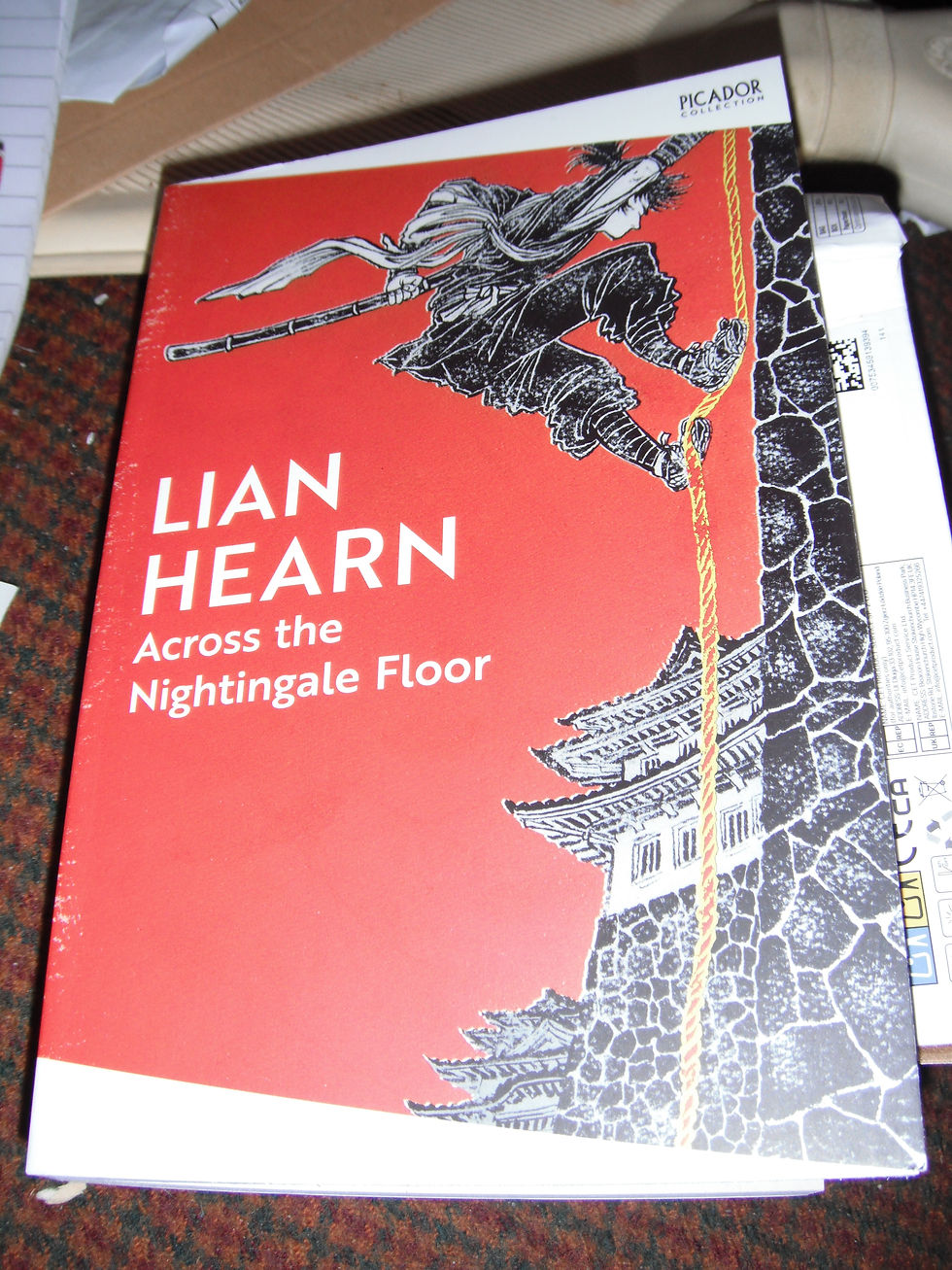
Spoiler Alerts
Across The Nightingale Floor is the first of a series of (currently) five novels – (possibly seven if you include the splinter works on the ‘Children Of Otori’ as well). The novel is set in a fictional version of Japan at the height of an era when small but powerful principalities were ruled by often tyrannical leaders surrounded by samurai, ninjas and assassins.
When a young man called Tomasu survives the slaughter of his family and most of his clan, by a fierce warlord called Lida. Has his name changed to Takeo, by a protective man called Shigeru, who is in love with a woman called Maruyama.
Another figure arrives, a warrior called Muto Kenji, of a Hidden tribe known simply as The Tribe. Recognises that Takeo has latent super-powers of telepathy, the ability to be in two places at once and invisibility, which Takeo then seems to use very sparingly, often not bothering with them even when they might be rather useful. Muto seems to be in the book mainly for exposition dumping. Given how isolated he has been for much of his life he somehow knows everything without having sources or direct eyewitness observation.
After a failed assassination attempt, Takeo & Shigeru realise that Lida wants them dead and plan to intercept him first. This is difficult as the tyrant has a large nightingale floor in his fort, which is impossible to cross without it setting off alarm noises supposedly comparable to a singing nightingale.
Such floors were a genuine security system for many warlords in Feudal Japan. There are some in museums to this day, but they do not sound like a song bird, more like a trapped, badly injured cat screeching in agony. You could probably sort it out with a can of WD40 nowadays, lol. Here is a Youtube of one in action. https://www.youtube.com/watch?v=V8nXhOBUkh8&t=123s Takeo plans to use his superpowers to get over Lida’s floor silently and undetected. He even gets one built to practice on. I was reminded in this of the scenes in the TV series Kung Fu, with David Carradine’s Kane having to learn how to walk over long sheets of rice paper without tearing them (this was used in the opening credits each episode after being introduced). https://www.youtube.com/watch?v=kSZz9b20kow
Meanwhile, a young woman called Kaeda a hostage to Lida since childhood, who has had to fend of rapists in his army. She has some protection by Maruyama, and it is clear that Kaeda and Takeo are bonding. However, on route to Lida’s fortress with Takeo keen to undertake his assassination attempt on the warlord, he is abducted by his clansmen who want to train him and develop his full super-powered potential. After this, everything becomes rather anti-climatic.
1/. The central floor crossing challenge. Takeo seemed to be training in moving his feet on the floors without triggering the alarms but with others trampling over the floor he just rushes over it with them, creating noise.
2/. Lida – The main antagonist barely appears and with all the build up to Takeo having to take him down in some kind of epic confrontation, the Warlord is actually killed off-page by Kaeda.
3/. Takeo & Kaeda – They absurdly fall in love at first sight and immediately decide that they could never be happy with anyone except each other. They don’t really get to develop their relationship but do get an odd love making session right by the corpse of Lida, Knowing they are due to be forcibly separated, Kaeda requests a suicide pact as she feels unable to live without Takeo by her side, at which point he hypnotises her into an unconscious state and goes off with the Tribe, paying homage to Shigeru’s burial site on the way to his next adventure. Whether she takes her own life on snapping out of her trance or chases after Takeo in future books in the series is unknown at this stage. His jilting of her with hypnosis seems worse than dumping your partner by text.
4/. Takeo’s super-powers Takeo learns to use invisibility, a gift he masters in literally one sentence, but then he barely employs this or other skills, even in combat with Lida’s bodyguard. He does use it during part of his errand of mercy when he puts some tortured prisoners out of their misery. He later does it again for Shigeru, and it doesn’t seem as tense as the first time. I felt the book would work better as a straight forward tribal war story without assassins having convenient super-powers unmatched by their opponents.
5/. Takeo Sneaking out – Though under instructions from Shigeru not to leave the grounds of his residence, Takeo sneaks out into the town and gets identified by a spy as well as meeting Muto, but he goes out doing this right after foiling an assassination attempt, so he endangers himself and Shigeru right after seeing what the enemy intends to do and can do.
6/. The Hidden – They are not very good at hiding as everyone seems to know who they are and recognise them easily.
7/. Off Page deaths – Key characters meet their fate off the page, with Takeo discovering the events later. Lida’s death at Kaeda’s hands, Maruyama’s drowning, with her daughter, etc.
8/. Takeo’s lack of emotion. - He doesn’t get too shocked by the death of his family and most of his village, or by the near suicide pact with Kaeda. When he seperates from her, in favour of homage to Shigeru and completion of his training by thde Tribe he doesn’t seem to feel any emotional distress about the girl he previously felt unable to live without. Earlier His mute state was attributed to his powers kicking in rather than being down to the emotional distress of seeing everyone he knew slaughtered.
9/. Earthquakes – Japan has more of these than any other country on Earth so having them referred to in the text is not surprising, but they have no bearing on the plot at all.
A complex web of intrigue that seems to move away from much that it promises and sets up for. Far from boring, and with great period detail, but uncertain what genre it wants to involve most. I don’t feel I want to go on to the rest of the series.
Massive thanks to Vinyl Tap, book group organiser, Millie Angel, and Andy Turner who selected this book.

The next book picked out was Daniel Keyes’s Flowers For Algernon, (1966), one suggested by myself. (Members put suggestions in a glass from which a title was picked for the month long reading session between meetings) Hope everyone enjoys what is one of my favourite novels of all time.
Photos by me.
Arthur Chappell


Comments